
Appearance
Languages
Leathercase keeps three languages apart: the language the app speaks to you, the language each story is written in, and the language of the book an export writes. They differ more often than you might think. A Brazilian novelist may run the app in Portuguese while drafting a novel in English, and a Lisbon screenwriter may keep the app in English while writing in Portuguese. Tying the three together would get one of them wrong for that writer, so each has its own setting.
The three languages
| Language | What it decides | Where you set it | Kept |
|---|---|---|---|
| The app's | Menus, labels, buttons, the Desk's sentences, dates and numbers in the interface | Settings, Appearance, Language of the app | On this computer only |
| The story's | How the prose is read (names, honorifics, pronouns, which little words are not names) and the words Leathercase writes for the story: beats, template acts and scenes, columns | Story settings, Language | In the story's Story.json, so it travels with the story |
| The book's | The words an export writes into the manuscript: "Contents", "Chapter One", "by", "END", the scene break, "about 1,000 words", the file's name | Follows the story's language |
The app's language never reaches your files or your book. A Portuguese story exported from an English desk reads "Capítulo Um" and "cerca de 1.000 palavras", with no "Chapter" or "about" in it.
Reading is not translating
Leathercase reads more languages in your files than the app is translated into. Reading means it finds names, pronouns, titles and folder names in your prose and your folders, whatever language the app speaks to you. Translating means the app's own menus and labels are in that language.
| Languages | |
|---|---|
| Recognised in your files | English, Portuguese, Spanish, French, German, Italian |
| The app is translated into | English (United States, United Kingdom, Canada), Portuguese (Brazil, Portugal) |
A Spanish novel opened in the app's English is read as Spanish: its Personajes/ folder is the cast, and "ella" finds the woman just named. The app's labels stay in English.
The app's language
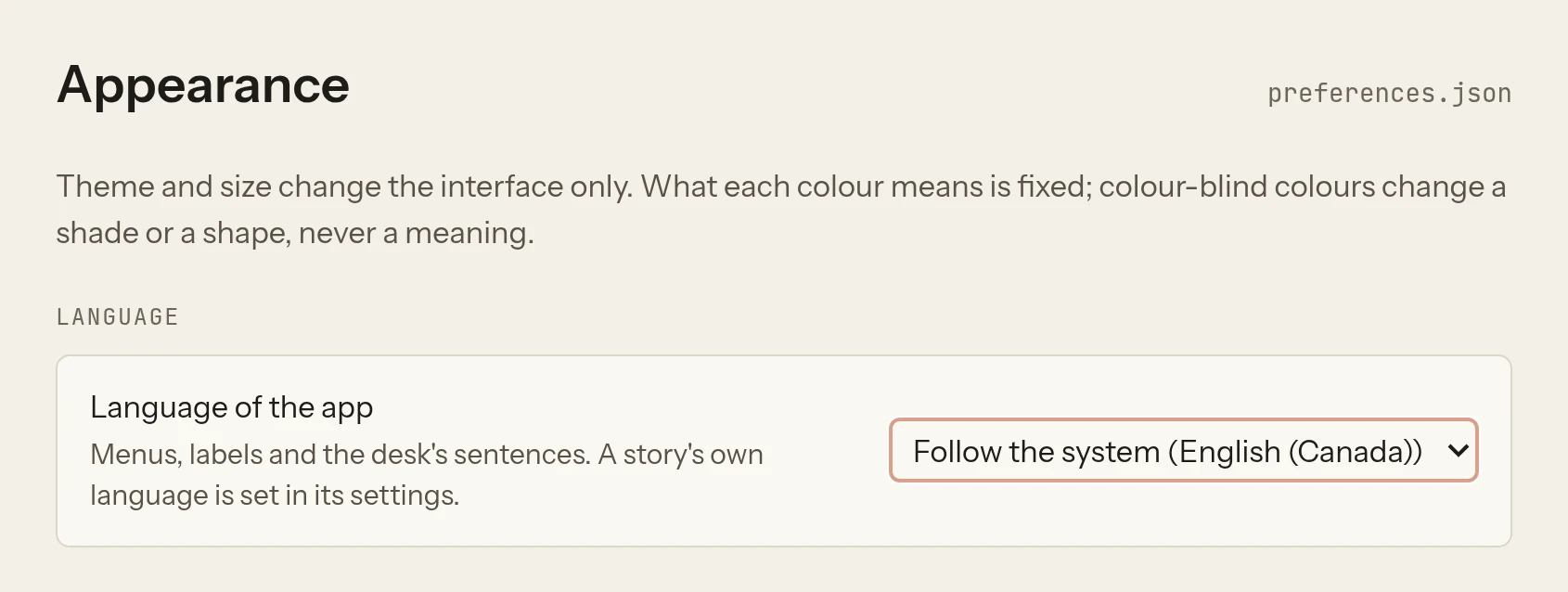
The app speaks the language of the computer it runs on, matched to the nearest language it carries, until you pick another.
- Open Settings (
Ctrl+,, orCmd+,on macOS). - Choose Appearance.
- Under Language, pick from Language of the app: Follow the system (the line names the language it found), or one of the languages below.
The change applies at once, to the window and to the native menus (File, Edit, Story, View). It is this computer's choice: another computer that syncs the same writing home keeps its own. In the menus, the few items the system words itself, such as Quit, Cut and Paste, follow the system's.
Languages the app carries
| Language | Shown as | How it is made |
|---|---|---|
en-US | English (United States) | The source: every string is written here first |
en-GB | English (United Kingdom) | British spelling and quotes; only what differs from en-US |
en-CA | English (Canada) | Canadian spelling; only what differs from en-US |
pt-BR | Português (Brasil) | A full translation |
pt-PT | Português (Portugal) | European Portuguese vocabulary and grammar; only what differs from pt-BR |
A message an overlay does not change comes from the language it is built on: en-GB and en-CA from en-US, pt-PT from pt-BR and then en-US.
How "Follow the system" chooses
Leathercase reads the languages your system lists, in their order, and takes the first it can match:
| Your system says | The app speaks |
|---|---|
pt-BR, or pt with no region | Português (Brasil) |
pt-PT, pt-AO, pt-MZ or Portuguese of any other region | Português (Portugal) |
en-GB, en-IE, en-AU, en-NZ, en-IN, en-ZA, en-SG, en-HK, en-MT | English (United Kingdom) |
en-CA | English (Canada) |
en-US, en with no region, or English of any other region | English (United States) |
| A language the app does not carry yet | The next language in your system's list, else English (United States) |
So a system set to French, then Portuguese (Brazil), gets the app in Brazilian Portuguese.
On Windows the installer and uninstaller speak English (United States), Português (Brasil) or Português (Portugal).
The story's language
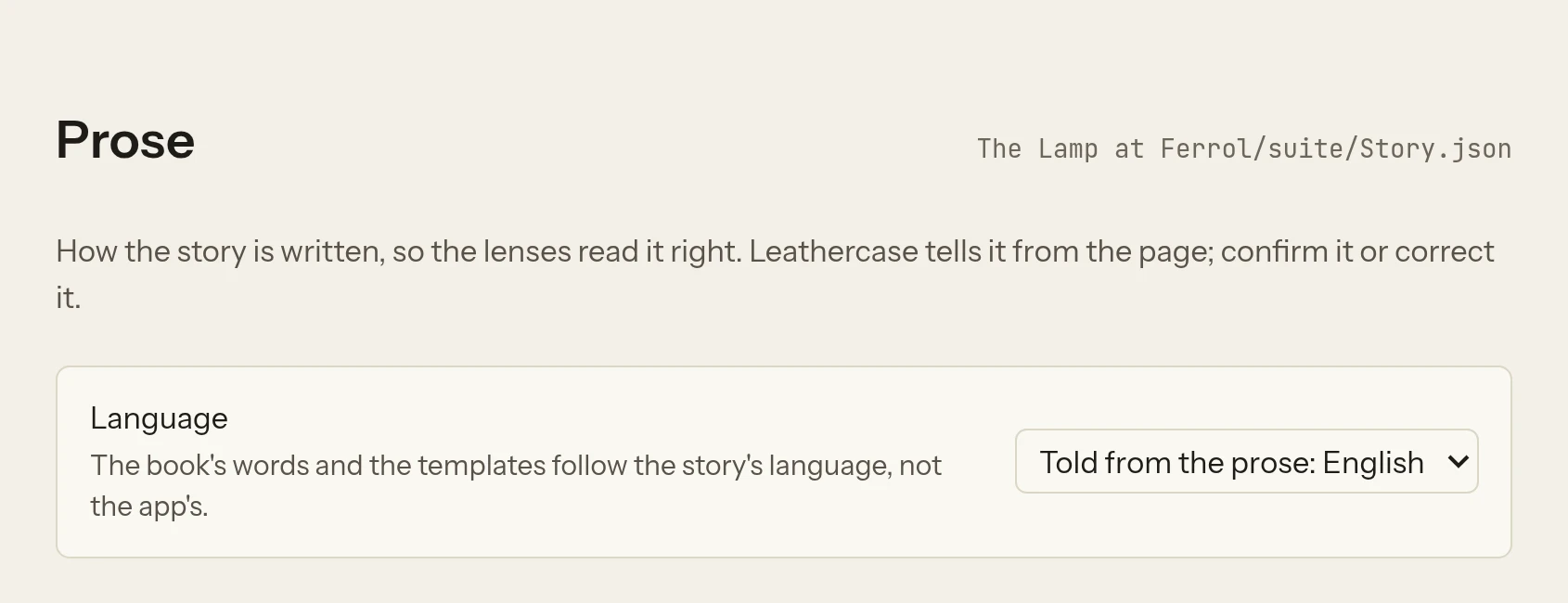
Each story has its own language. Until you set one, Leathercase tells it from the prose, by which language's commonest little words the text uses most ("the", "and", "of"; "de", "que", "não"; "el", "y", "una"). It can tell English, Portuguese, Spanish, French, German and Italian apart, and needs a few sentences to be sure; until then it reads the story as English. Told from the prose, it is only a language, never a region: Brazilian and European Portuguese share their little words.
To set it:
- Open the story, then Story settings from the story's menu in the breadcrumb or the sidebar, or from the Story menu.
- Choose Prose in the list on the left.
- In Language, the first choice says what the prose told Leathercase: Told from the prose: English, or Told from the prose (English until there is enough). Pick one of the five languages above to set it yourself. The hint beside the row says The book's words and the templates follow the story's language, not the app's.
Set it when the guess is wrong, or when you want the book's words in a regional spelling: a story set to Português (Portugal) gets European Portuguese chapter numbers.
What follows the story's language
| What | Example in a Portuguese story |
|---|---|
| The beat board's templates and beats | Três atos, with the act Ato I holding Abertura, Incidente incitante, Primeira virada |
The acts and scenes a grid template writes into PlotGrid.md | ### Incidente incitante |
The columns a template writes into StoryThreads.md | ## Theme: Tema principal |
| The book's words in an export | "Capítulo Um", "Sumário", "cerca de 1.000 palavras" |
The head of the sentence log, and the readable copy of an agent's proposal kept in suite/assistant/changesets/ | in Portuguese |
| How the prose is read | Portuguese pronouns, articles and honorifics first |
The threads note keeps its grammar in every language: the Arc:, Theme: and Subplot: prefixes, the stop words plant:, payoff:, reversal:, and the beat: comment stay as they are, so a threads file reads the same way whatever language its story is in.
Chapter numbers are spelled out in English and Portuguese ("Chapter Twelve", "Capítulo Doze"). For a story in Spanish, French, German or Italian the book's words come from English until the app carries those languages, and chapter numbers are written as digits.
Reading a story that mixes languages
The story's language goes first, but Leathercase reads every language it knows in every story. A Portuguese line of dialogue in an English novel is read as Portuguese: "Inés encontrou a Nora no cais. Ela sorriu." finds Nora by "Ela". Titles at the head of a name are known in all six languages, so "Father Amaro", "Dona Inés", "Madame Roca" and "Herr Kell" each find their character and tell their pronoun.
The style checks (adverbs, clichés, filter verbs, passive voice and the others) are built on English word lists, so they find little in prose written in another language.
Folder names in every language
A note is a character, place, item, faction or event when it sits in a folder named for its kind, and Leathercase reads those names in six languages, singular or plural, in any case. When a note's front matter says type:, the type wins over the folder.
| Kind | English | Português | Español | Français | Deutsch | Italiano |
|---|---|---|---|---|---|---|
| Character | Characters, Character, People, Cast, Dramatis personae, NPC, NPCs | Personagens, Personagem, Pessoas, Elenco | Personajes, Personaje, Personas, Reparto | Personnages, Personnage, Personnes, Distribution | Figuren, Figur, Personen, Charaktere, Besetzung | Personaggi, Personaggio, Persone, Cast |
| Place | Places, Place, Locations, Location, Settings, Setting, World, Worldbuilding, Geography, Maps, Map | Lugares, Lugar, Locais, Cenários, Mundo, Geografia, Mapas | Lugares, Lugar, Ubicaciones, Escenarios, Mundo, Geografía, Mapas | Lieux, Lieu, Endroits, Décors, Monde, Géographie, Cartes | Orte, Ort, Schauplätze, Welt, Geographie, Geografie, Karten | Luoghi, Luogo, Ambientazioni, Mondo, Geografia, Mappe |
| Item | Items, Item, Objects, Object, Artifacts, Artifact, Artefacts, Artefact | Objetos, Objeto, Objectos, Itens, Artefatos, Artefactos | Objetos, Objeto, Artefactos | Objets, Objet, Artefacts | Gegenstände, Gegenstand, Objekte, Artefakte | Oggetti, Oggetto, Artefatti |
| Faction | Factions, Faction, Organisations, Organizations, Organisation, Organization, Houses, Groups | Facções, Facção, Organizações, Grupos | Facciones, Facción, Organizaciones, Grupos | Organisations, Groupes | Fraktionen, Fraktion, Organisationen, Gruppen | Fazioni, Fazione, Organizzazioni, Gruppi |
| Event | Events, Event, Timeline, History | Eventos, Evento, Cronologia | Eventos, Evento, Cronología | Événements, Évènements, Événement, Chronologie | Ereignisse, Ereignis, Zeitleiste, Chronik | Eventi, Evento, Cronologia |
Folders that hold notes about the story rather than the story itself are read in the same languages:
| Role | Folder names |
|---|---|
| Prose | Manuscript, Chapters, Scenes, Draft, Drafts; Manuscrito, Capítulos, Cenas, Rascunho, Rascunhos; Escenas, Borrador, Borradores; Manuscrit, Chapitres, Scènes; Manuskript, Kapitel; Capitoli, Bozza, Bozze |
| Plan | Outline, Outlines, Planning, Plans, Synopsis; Esboço, Esboços, Planejamento, Planeamento, Sinopse, Escaleta; Planificación; Synopse, Planung; Scaletta |
| Record | Style sheet, Continuity; Continuidade; Continuidad |
| Work notes | Journal, Feedback, Revisions, Revision notes, Critiques; Diário, Revisões, Revisão, Notas de trabalho; Diario, Revisiones; Überarbeitung |
| Research | Research, Sources, Resources, References, Clippings; Pesquisa, Pesquisas, Fontes, Referências; Investigación, Fuentes; Recherche, Recherches; Quellen, Recherchen; Ricerca, Fonti |
| Scraps | Cut, Cuts, Scraps, Archive, Extras, Deleted scenes, Outtakes, Trash; Cortes, Cenas cortadas, Arquivo, Lixo, Lixeira, Descartes; Archivo, Escenas eliminadas; Archives; Archiv; Archivio |
A word two roles could claim, such as "Notes" or "Story", is left out on purpose: Leathercase asks what such a folder holds instead of guessing. The type: words a note can carry are listed in Front matter; they are read in the same six languages.
A new story Leathercase starts for you gets its cast and world folders (Characters/, Places/, Items/, Factions/, Events/) named in the story's language when one is set as it starts, otherwise in the app's: Personagens/, Lugares/, Objetos/, Facções/, Eventos/ in Portuguese.
Reporting a wrong word
The app's translations are written from the English source with a shared glossary, so Leathercase names things the same way on every screen. If a label reads wrong in your language, too literal, the wrong register, a Brazilian word in the Portuguese of Portugal, say which screen and which words. Each fix is one line in one file, made for the next release. Spanish, French, German, Japanese, Korean and Chinese are planned; the app does not carry them yet.